Defects of paint coatings affecting durability
Cratering in Coatings
Description: Macroscopic round depressions in the coating.

Causes:
- Excessive coating thickness
- Insufficient surface preparation before painting; use of inappropriate degreasers
- Poor cleaning of compressed air used for spraying
- Presence of airborne contaminants, e.g., from polishing compounds
Boiling in Coatings
Description: Small, partially burst bubbles on the coating surface.

Causes:
- Excessive coating thickness
- Insufficient flash-off time between layers and before oven curing
- High coating viscosity
- Use of hardeners and solvents unsuitable for application and curing temperature conditions
Wrinkling in Coatings
Description: Small folds throughout the coating thickness, resembling frog skin.

Causes:
- Incompatibility between coating layers or with the substrate; solvent from the top layer penetrates sensitive substrates and dissolves them
- Incorrect timing between application steps
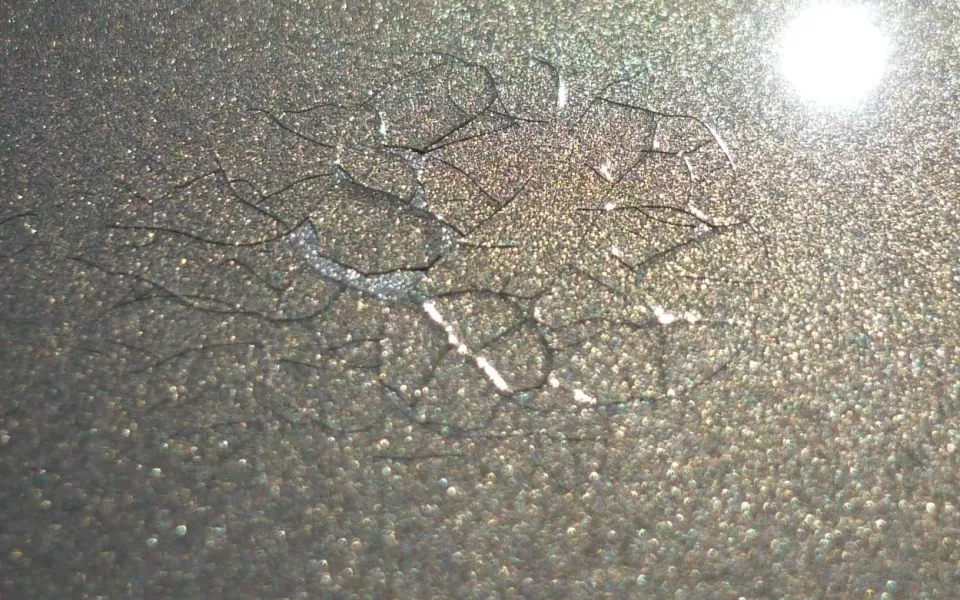
Cracking in Coatings
Description: Formation of splits in the dried coating.

Causes:
- Excessive coating thickness
- Low coating viscosity
- High spray pressure or too close spraying distance
- Unsuitable application conditions (low temperature, high humidity)
Contamination in Coatings
Description: Foreign particles on or within the coating.

Causes:
- Poor cleaning of the surface
- Dirty spray gun
- General contamination of the painting area
- Insufficient filtration of coating material
- Static charge on the painted part
Blistering in Coatings
Description: Small pinpoint bubbles filled with air or water, ranging from 0.1 to 4 mm.

Causes:
- Moisture on the surface or in the air
- Coating lacks water resistance or is insufficiently dried
- Excessive temperature during curing
Poor Adhesion
Description: Coating does not adhere or adheres poorly to the surface.

Causes:
- Contaminated substrate
- Excessive coating thickness
- Violation of application technology or unsuitable conditions
- Incompatibility between coatings or with the substrate
- Insufficient substrate roughness
Important Notes for Defect Prevention
- It’s always easier to prevent defects than to fix them.
- Coatings with durability-affecting defects must be removed.
- Repaired coatings are generally inferior to original finishes.
- Two-component coatings are easier to repair.
- Do not use solvent for degreasing.
- Follow the application technology strictly.
- When in doubt, take extra precautions.
- Enamel does not correct substrate or surface preparation defects.
We offer coatings that enhance appearance and extend product life while supporting performance and sustainability goals. Our solutions include not only coatings but also expertise, tools, equipment, consumables, and industry-leading support.